| |
Copyright (c) 2019
All Rights Reserved
amortization.com Ltd.
Burlington, Ontario
CANADA
905-639-0374
905-407-7988
info@amortization.com



Amortization Pro for iPhone/iPad/iPod
|
|
Negative
Amortization Schedule |
- When mortgage or loan payments are in excess of the interest due,
it is a normal amortization schedule. The balance owing decreases after
every payment.
- When mortgage or loan payments are exactly equal to the interest due,
it is called an interest only schedule. The balance owing remains the
same after each payment.
- When mortgage or loan payments are less than the interest due, it
is called a negative amortization schedule. The balance owing increases
after each payment, because the missing interest is added to the balance.
- When mortgage or loan payments are set to zero in the MORTGAGE2 PRO
amortization schedule the schedule becomes an expanded Present
Value Future Value grid.
A
negative amortization schedule
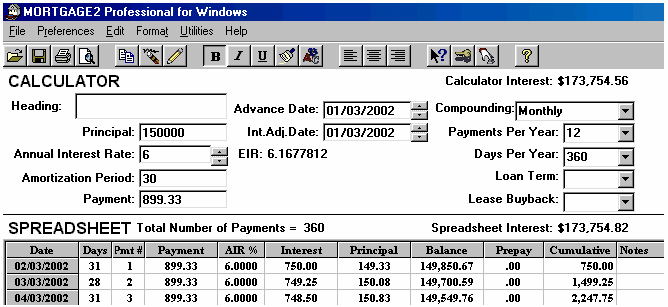
What if a lender offered you a $150,000 loan (or mortgage) at 6% for 30
years and told you the monthly payments would be $600 per month. This
may sound like a sweet deal but be cautious! If you had an amortization
schedule you notice that the blended monthly payments for 30 years would
have to be $899.33 in order to retire the loan.
(Screenshot 1)
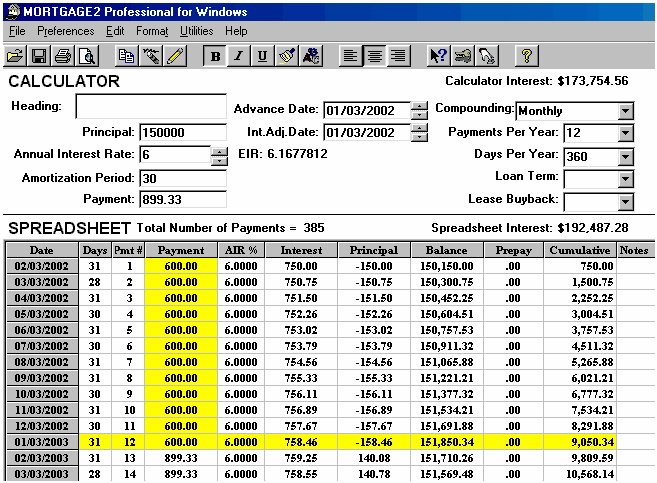
In fact if you only paid $600 per month the loan would never be paid
off. The balance owing would continue to increase with time because it
is a negative amortization schedule. In fact some lenders have been known
to entice new borrowers with a variation of this technique.
Offer the borrowers $600 per month for the first year then switch them
to the regular payments of $899.93
(Screenshot 2)
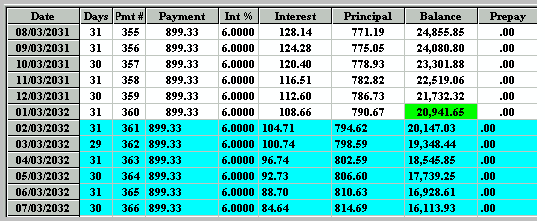
After 30 years of payments,... surprise surprise ... you still owe a
balance of $20,941.65
(Screenshot 3)
|
|
 VIDEOS VIDEOS
amortizationdotcom Mortgage Calculator for iPhone
Introduction to Canadian and American Mortgages
Seminar on prepaying principal (Part A)
Seminar on prepaying principal (Part B)
Global TV Interview regarding 40 Year Mortgages

Look for this logo on the Apple Store!
|